







By Dr Kurtis Irwin, CEO CATAGEN Green Emissions Testing
This fifth blog continues our 6-part series, Overcoming Barriers: Confidence in Catalyst Durability, exploring how OEMs and technology partners can move from testing challenges to proven performance.
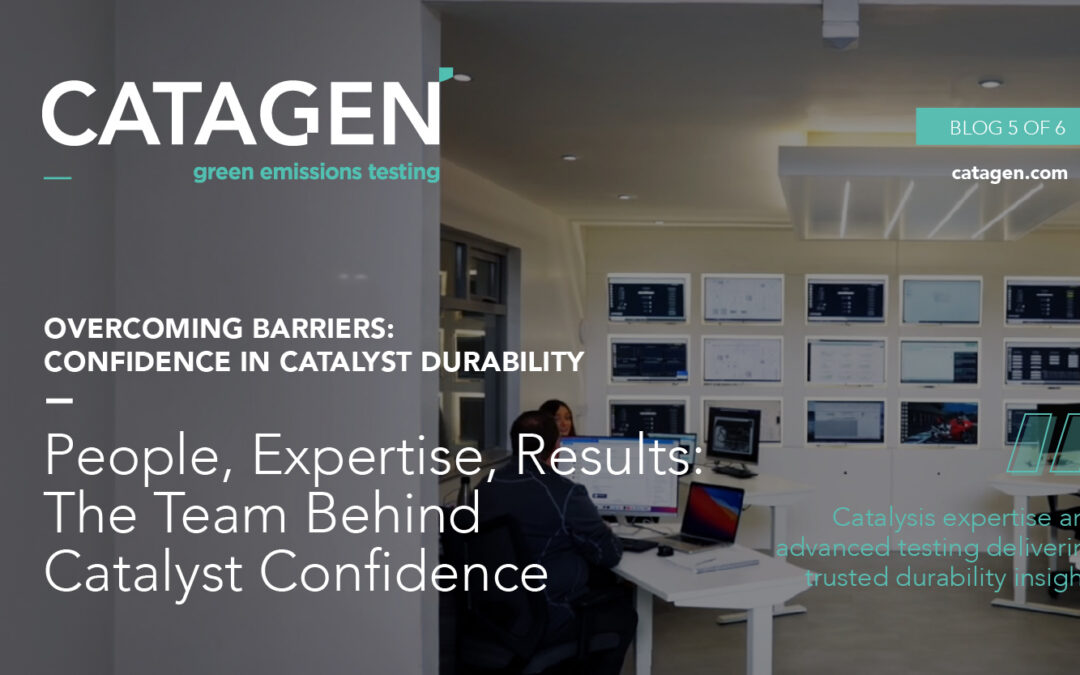
In the previous blog, we examined the technology behind representative catalyst ageing and how advanced testing methods can provide more meaningful durability data. But data alone does not build confidence. The real value comes from understanding why catalysts degrade, how different ageing mechanisms interact, and what the results mean for long-term performance. In this article, we explore the people, expertise, and scientific insight that sit behind every successful catalyst durability programme.
People, Expertise, Results: The Team Behind Catalyst Confidence
Executive Summary
Catalyst durability testing is not simply a question of generating data. The real challenge lies in understanding what that data means, identifying the mechanisms driving degradation, and translating results into confident engineering decisions.
At CATAGEN Green Emissions Testing, our multidisciplinary team combines expertise in catalysis, chemical engineering, process development, and advanced durability testing to help partners move beyond observation and towards understanding. With PhD-level specialists, published research, patented technologies, and experience supporting more than 50 global partners, we help organisations transform durability uncertainty into actionable insight.
In this blog, we explore why expertise matters just as much as technology when it comes to understanding catalyst performance and building confidence in long-term durability.
Why expertise matters in catalyst durability testing
Durability testing generates data. Expertise turns that data into understanding.
A catalyst may show declining conversion, reduced selectivity, increasing pressure drop, or changes in product composition over time. However, identifying the root cause of those changes is often far more complex than simply measuring performance loss.
Is the catalyst experiencing thermal sintering? Has it been poisoned by trace contaminants? Is fouling restricting mass transfer? Or are transient operating conditions accelerating degradation in ways that would never appear during steady-state testing?
Answering these questions requires more than instrumentation. It requires a deep understanding of catalyst chemistry, degradation mechanisms, reactor operation, and industrial process conditions.
This is where specialist expertise becomes essential.
Scientific expertise behind every programme
At CATAGEN Green Emissions Testing, catalyst ageing programmes are supported by a team of scientists and engineers with extensive experience across catalyst development, emissions control, fuel processing, reforming technologies, hydrogen systems, and industrial process optimisation.
Our team includes PhD researchers and specialists whose work focuses on catalyst behaviour, degradation mechanisms, accelerated ageing methodologies, and long-term performance prediction. Beyond customer programmes, CATAGEN’s experts actively contribute to the advancement of catalyst science through technical publications, white papers, collaborative research projects, and presentations at leading international conferences.
This combination of academic rigour and industrial experience ensures that every testing programme benefits from both scientific understanding and practical engineering application.
Experience across catalyst applications
Over years of research and customer collaboration, CATAGEN has developed expertise across a wide range of catalyst technologies and industrial sectors.
This includes reforming catalysts, water gas shift catalysts, emissions after-treatment systems, SOFC-related technologies, hydrogen production processes, petrochemical applications, renewable fuel systems, and industrial process catalysts.
The team has extensive experience studying the mechanisms that drive catalyst ageing, including thermal sintering, coking, poisoning, fouling, support degradation, and mechanical attrition.
As a result, when CATAGEN designs a durability programme or interprets ageing data, the approach is tailored to the specific catalyst, process, and operating environment rather than relying on generic testing methodologies.
From data to engineering decisions
The ultimate goal of catalyst durability testing is not to produce more data. It is to help engineers make better decisions.
Whether supporting a catalyst developer validating a new formulation, an OEM preparing for commercial deployment, or an operator evaluating alternative fuels, the objective remains the same: understanding how a catalyst will behave in the real world and what actions should be taken as a result.
This might involve predicting catalyst lifetime with greater confidence, optimising regeneration intervals, understanding contaminant tolerance limits, comparing catalyst formulations, validating performance under alternative fuels, or supporting warranties and reliability targets. Ultimately, the value lies not only in measuring degradation, but in understanding why it occurs and what can be done about it
Proven through collaboration
To date, CATAGEN Green Emissions Testing has supported more than 50 global partners across automotive, heavy-duty, marine, industrial, hydrogen, and energy sectors.
These collaborations have helped organisations:
- – Reduce uncertainty around catalyst lifetime
- – Improve reliability and operational confidence
- – Validate new technologies before deployment
- – Support performance guarantees with empirical durability evidence
- – Accelerate development programmes through representative ageing data
Each programme contributes to a growing body of knowledge that strengthens CATAGEN’s understanding of catalyst behaviour across a wide range of applications and operating environments.
Turning durability data into catalyst confidence
Catalyst durability is ultimately a scientific and engineering challenge. While advanced testing platforms are essential, technology alone cannot explain why catalysts degrade, how quickly performance will change, or what actions should be taken next.
Confidence comes from combining representative testing with scientific expertise, practical experience, and a deep understanding of catalyst behaviour.
At CATAGEN Green Emissions Testing, that combination of people, expertise, and proven methodologies helps partners move beyond durability data and towards confident engineering decisions.
Next Up
Technology, data, and expertise all play a role in building catalyst confidence. But as the energy transition accelerates and operating conditions continue to change, the industry must also rethink how durability is assessed and validated.
In the final blog of this series, we look ahead to the future of catalyst durability testing and the challenges and opportunities that lie ahead for catalyst developers, OEMs, and technology providers.
About CATAGEN
CATAGEN provides Green Emissions Testing to accelerate OEMs’ aftertreatment system development and ensure emissions compliance worldwide. Its patented OMEGA Reactor offers a sustainable method of catalyst aging without an engine, saving customers time, cost, and carbon.
CATAGEN Green Emissions Testing is part of the CATAGEN Group, whose mission is to clean and decarbonize the air through innovation across multiple subsidiaries, including Green Flight (for Sustainable Aviation Fuel production) and Hydrogen Compression Technologies.
BLOG SERIES-
OVERCOMING BARRIERS: CONFIDENCE IN CATALSYT DURABILITY

Supporting our partners obtain certification with
Queen’s Road, Titanic Quarter,
Belfast, N. Ireland BT3 9DT
Tel: +44(0)2890455100
Follow us: