





By Dr Kurtis Irwin, CEO CATAGEN Green Emissions Testing.
This fourth article continues our 6-part series, Overcoming Barriers: Confidence in Catalyst Durability, exploring how OEMs and technology partners can move from testing challenges to proven performance.
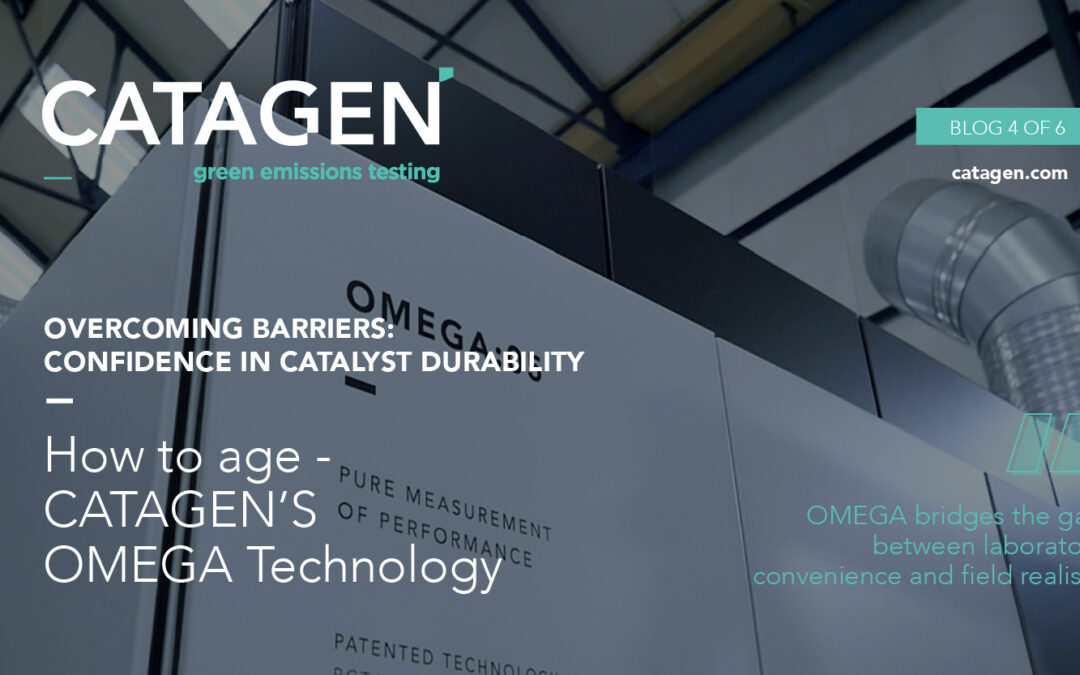
Having explored why durability matters, why catalyst lifetime is difficult to predict, and the limitations of conventional testing approaches, the next question is clear: what does a better testing methodology look like? In this article, we examine how CATAGEN’s OMEGA Reactor combines industrial realism with laboratory precision to generate representative ageing data and deliver greater confidence in catalyst durability and lifetime prediction.
Executive Summary
In our previous blog, we explored why catalyst ageing cannot be ignored, the hidden costs, performance risks, and operational uncertainty caused by relying solely on lab-scale tests and assumptions.
This blog focuses on the how: how to generate real, representative durability insights without the cost and downtime of full-scale plant trials. We introduce CATAGEN’s OMEGA Reactor, an advanced recirculating synthetic gas system that accurately simulates industrial conditions, thermal cycling, contaminant dosing, and variable gas compositions with precision and repeatability. It bridges the gap between laboratory convenience and field realism, delivering the high-fidelity data engineers need to truly understand catalyst deactivation mechanisms, optimise regeneration strategies, and de-risk process design.
The challenge: replicating reality in controlled conditions
Traditional catalyst durability testing is slow, resource-intensive, and often fails to replicate the complex transients and stressors catalysts face in real-world operation. Pilot plant campaigns require large quantities of feedstock and weeks or months of testing, while microreactor or bench-scale tests lack the necessary fidelity to capture industrial thermal gradients, start-stop cycles, and contaminant ingress.
Catalysts in the field experience extreme temperature ramps, transient oxidation/reduction environments, trace poisons at ppm/ppb levels, and variable space velocities all of which accelerate or alter deactivation pathways. Accurately reproducing these combined effects in a controlled test environment has historically been a significant barrier.
This is where CATAGEN’s OMEGA Reactor closes the gap.
The OMEGA approach: precision, control, and repeatability
The OMEGA Reactor is an advanced recirculating synthetic gas system specifically engineered to simulate industrial operating environments with high fidelity. Unlike single-pass rigs, its closed-loop design maintains stable conditions while significantly reducing gas consumption.
Key features include:
- – Recirculating synthetic gas environment. Precisely controlled gas compositions mimic refinery syngas, reformer feeds, or exhaust mixtures including trace contaminants such as sulphur, phosphorus, alkali metals, and chlorides.
- – Dynamic thermal cycling. High-precision e-furnace technology reproduces the temperature ramps, dwell times, and rapid transients encountered during start-up, shutdown, or load changes. Temperature uniformity within ±2 °C ensures realistic but repeatable thermal stress.
- – Variable space velocities. Flow rates are fully programmable, allowing simulation of conditions at industrially relevant levels.
- – Targeted contaminant dosing. Controlled injection of catalyst poisons (e.g. sulphur species, biofuel contaminants) allows isolation of specific deactivation pathways.
- – Real-time monitoring and analytics. Gas analysis, temperature profiling, and data logging provide continuous measurement of reaction products and deactivation markers
The result is a test platform that combines industrial realism with laboratory repeatability, enabling mapping of deactivation kinetics under multiple stressors.
Why recirculating synthetic gas matters
Conventional reactor systems often require large volumes of feedstock and can generate significant emissions during long-duration durability programmes. By recirculating a synthetic gas mixture, the OMEGA Reactor dramatically reduces gas consumption by up to 75%, lowering both operating costs and environmental impact while maintaining stable, homogeneous reaction environments. This eliminates many of the inconsistencies associated with feedstock variability and provides the enhanced safety, repeatability, and process control required for long-duration ageing studies and controlled contaminant dosing. As a result, tests can be run for extended periods or accelerated timescales while maintaining precise control over the conditions that drive catalyst ageing and degradation.
Technical benefits for catalyst ageing studies
With its combination of high-fidelity industrial simulation and precise experimental control, the OMEGA Reactor delivers insights that are difficult to achieve through conventional testing methods. Engineers can generate accurate time-on-stream performance curves across multiple operating scenarios, providing quantified deactivation kinetics and a clearer understanding of how catalyst performance changes over time. The platform also enables isolation of key degradation mechanisms, helping distinguish whether performance loss is driven by thermal sintering, poisoning, fouling, or support degradation, information that is critical when refining catalyst formulations or regeneration strategies.
By differentiating between reversible and irreversible deactivation pathways, OMEGA helps determine which performance losses can be recovered through regeneration and which ultimately require catalyst replacement. The system also enables validation of catalyst performance under alternative fuels, bio-derived feedstocks, and varying contaminant profiles before committing to plant-scale deployment. Combined with industry-leading repeatability of less than 2% variance, this allows robust benchmarking of catalyst formulations, reactor designs, and operating strategies, giving engineers greater confidence in both development and scale-up decisions.
Turning ageing into actionable data
The OMEGA Reactor transforms catalyst durability testing from a lengthy, costly, and uncertain process into a fast, precise, and highly informative workflow. Instead of relying on conservative assumptions or incomplete lab data, operators and catalyst suppliers gain:
- – Predictive maintenance schedules informed by real ageing data.
- – Optimised regeneration cycles with minimal thermal stress.
- – Confidence in lifetime modelling, reducing warranty exposure.
- – Validated pathways for new feedstocks or cleaner process routes.
In short, OMEGA provides the understanding of catalyst behaviour under industrially relevant stressors that’s required for robust process design, reliable warranties, and de-risked operational economics.
Bridging the gap between lab and field
With reliable durability data, operators and technology providers can:
- – Optimise catalyst change-outs, reducing downtime and avoiding premature replacements.
- – Plan regeneration intervals with confidence, preventing unnecessary thermal stress or process disruption.
- – Back warranties and guarantees with empirical data, reducing commercial risk.
- – De-risk process innovation, validating catalyst robustness under new fuels or low-carbon operating modes.
- – Improve procurement decisions, benchmarking catalyst formulations under controlled but realistic conditions.
Ultimately, predictive certainty translates to operational confidence, lower costs, and stronger market differentiation.
From uncertainty to confidence
Most lifetime predictions today are educated guesses, constrained by lab tests that oversimplify the reality of industrial operation. But with controlled, representative ageing that mimics real-world stressors, you can build quantitative lifetime models that remove uncertainty.
You know how your catalyst will degrade, when performance thresholds will be crossed, and what mechanisms dominate under each operating scenario.
For processes where catalyst reliability defines emissions compliance, uptime, and profitability, predicting performance with certainty isn’t optional, it’s a necessity.
In the next blog, we’ll explore the barriers that make traditional testing slow, costly, and unreliable and how CATAGEN Green Emissions Testing can support.
About CATAGEN
CATAGEN provides Green Emissions Testing to accelerate OEMs’ aftertreatment system development and ensure emissions compliance worldwide. Its patented OMEGA Reactor offers a sustainable method of catalyst aging without an engine, saving customers time, cost, and carbon.
CATAGEN Green Emissions Testing is part of the CATAGEN Group, whose mission is to clean and decarbonize the air through innovation across multiple subsidiaries, including Green Flight (for Sustainable Aviation Fuel production) and Hydrogen Compression Technologies.

Supporting our partners obtain certification with
Queen’s Road, Titanic Quarter,
Belfast, N. Ireland BT3 9DT
Tel: +44(0)2890455100
Follow us: